What Is Dharma? Understanding the Meaning of Dharma in Hindu Philosophy
Learn the true meaning of Dharma in Hindu philosophy, its spiritual importance, role in daily life, karma, morality, and traditional wisdom through authentic Kannada spiritual knowledge.
Introduction
Dharma is one of the most important concepts in Hindu philosophy and Indian spiritual traditions. It is often translated as duty, righteousness, moral order, or the path of truth.
However, Dharma has a much deeper meaning beyond simple rules or religious practices.
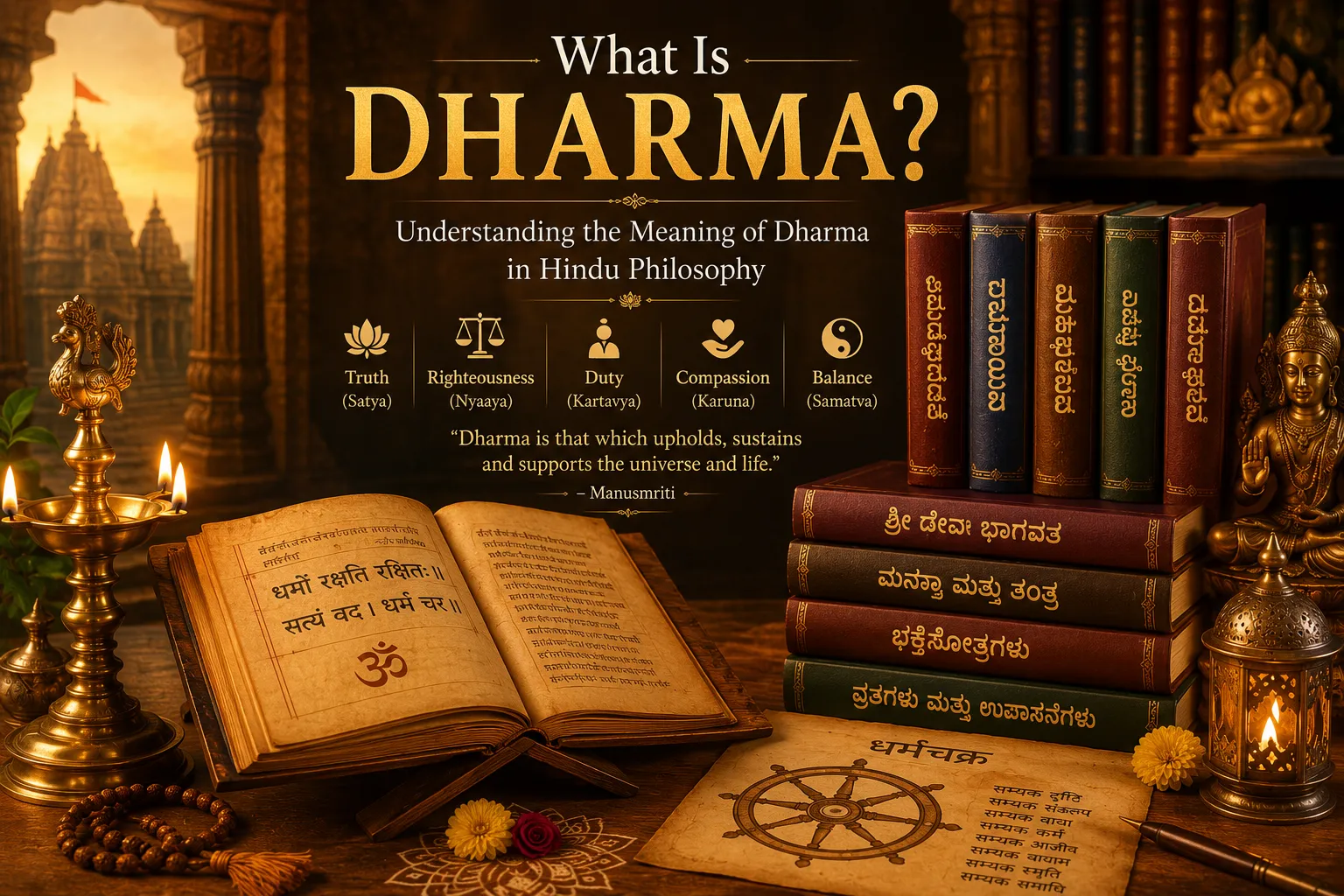
In traditional spiritual teachings, Dharma represents the natural way of living with truth, responsibility, balance, compassion, discipline, and harmony.
Ancient scriptures, Puranas, and spiritual books explain Dharma as the foundation of both personal growth and social well-being.
What Is Dharma?
Dharma refers to the principles that sustain life, morality, spirituality, and cosmic balance.
It guides individuals toward:
- Truthfulness
- Responsibility
- Compassion
- Self-discipline
- Justice
- Respect
- Spiritual growth
- Ethical living
In Hindu philosophy, Dharma helps people live in alignment with universal order and higher values.
Why Is Dharma Important?
Dharma creates balance in both individual life and society.
Without Dharma, people may experience confusion, conflict, selfishness, and emotional imbalance.
Traditional spiritual teachings explain that Dharma helps maintain:
- Mental peace
- Family harmony
- Social responsibility
- Spiritual progress
- Inner discipline
- Karmic balance
Dharma And Karma
Dharma and Karma are deeply connected concepts.
Karma refers to actions and their consequences, while Dharma guides people toward righteous actions.
Following Dharma is believed to create positive karma and spiritual growth.
This relationship is widely discussed in Hindu scriptures and spiritual literature.
Different Types Of Dharma
Traditional philosophy explains Dharma in different forms.
1. Personal Dharma
The responsibilities connected to one’s character, role, and life path.
2. Social Dharma
Responsibilities toward family, society, and community.
3. Spiritual Dharma
The journey toward self-realization, inner purity, and spiritual wisdom.
4. Universal Dharma
Values such as truth, compassion, non-violence, and honesty that apply to all people.
Dharma In Daily Life
Dharma is not limited to temples or religious rituals.
It can be practiced in daily life through:
- Honesty
- Helping others
- Respecting parents and teachers
- Fulfilling responsibilities
- Practicing kindness
- Living ethically
- Maintaining discipline
Even small positive actions are considered part of Dharmic living.
Dharma In Hindu Scriptures
Many Hindu scriptures discuss Dharma in depth, including:
- Bhagavad Gita
- Ramayana
- Mahabharata
- Puranas
- Dharmashastra texts
These texts explain how Dharma helps individuals navigate life challenges with wisdom and balance.
Why Learning Dharma Matters Today
Modern life often creates stress, confusion, emotional pressure, and lack of direction.
Traditional spiritual teachings on Dharma continue to provide guidance for:
- Mental clarity
- Ethical decision-making
- Emotional balance
- Spiritual understanding
- Purposeful living
This is why many people continue to explore spiritual books and ancient wisdom in today’s digital era.
Why Regional Language Spiritual Books Are Important
Learning spiritual concepts in one’s native language creates deeper understanding and emotional connection.
Kannada spiritual books help preserve traditional interpretations and make complex philosophical ideas easier to understand for readers of all ages.
Why Srinidhi Publications Is Trusted For Spiritual Books
Srinidhi Publications offers authentic Kannada spiritual and devotional books covering:
- Dharma
- Spiritual philosophy
- Puranas
- Jyothishya
- Mantras
- Stotras
- Vrata traditions
- Ancient wisdom
The mission is to preserve and share traditional Kannada spiritual knowledge for modern readers and future generations.
Frequently Asked Questions
What is the meaning of Dharma?
Dharma refers to righteous living, moral responsibility, truth, spiritual discipline, and universal balance.
Why is Dharma important in Hindu philosophy?
Dharma helps maintain personal, social, and spiritual harmony while guiding ethical and responsible living.
Is Dharma only related to religion?
No. Dharma also includes daily responsibilities, ethics, compassion, honesty, and righteous actions.
How can Dharma be practiced daily?
Dharma can be practiced through kindness, discipline, truthfulness, helping others, and fulfilling responsibilities sincerely.
Final Thoughts
Dharma is not only a philosophical idea. It is a practical guide for living with wisdom, balance, compassion, and responsibility.
Ancient spiritual traditions continue to teach that following Dharma helps people grow emotionally, morally, and spiritually while creating harmony in society.
For readers interested in traditional Indian wisdom, authentic Kannada spiritual books provide meaningful insights into Dharma and timeless spiritual knowledge.